Keep, Display or Store: Giving a Keepsake a Place
Keep, display or store a keepsake with less second-guessing: match its place to how often you want access and what the object means to you.
The most common keepsake mistake is treating “keep it” as a complete plan. The object stays, but its place does not suit it: a fragile postcard gets handled daily, a beloved cup disappears into a box, or a souvenir sits out mainly because moving it feels like a decision. Keep, display or store a keepsake by asking two questions first: how often do you want access, and what kind of significance does it hold for you?
Those questions are more useful than asking whether an item is important enough to deserve space. Importance does not dictate visibility. A private memento can matter deeply without being on a shelf, while an ordinary-looking object may be a pleasure to use every morning. The right place is the one that lets the object serve its meaning without creating avoidable friction.
Choose a place by access and significance
Think of the three options as different relationships with an object, not as rankings. Keeping means retaining it, whether it is in view or not. Displaying gives it a visible place and a role in the room. Storing puts it away while preserving the option to retrieve it. An object can move among these roles as your needs change.
- Keep it within reach if you use it or want to handle it often. A handwritten recipe, for instance, may belong in a kitchen file rather than behind glass.
- Display it if seeing it regularly brings pleasure, recognition or a useful reminder, and the object can tolerate its surroundings.
- Store it if it matters but you prefer privacy, need to protect it, or only want to see it at particular times.
Significance can come from several places: a connection to someone, a memory of a particular time, a personal achievement, or the object’s distinctive material and craft. You do not need to justify a keepsake to anyone else. But naming what you value can clarify whether seeing it, using it, or simply knowing it is safe best supports that meaning.
Access is practical, not abstract. If retrieving an item takes rummaging through a crowded closet, it is not readily accessible, even if you know it is there. If a display sits in a high-traffic spot where children, pets or passing bags may knock it, visibility may come with more attention than you want. Choose a place that fits the way you actually move through your home.
When a visible keepsake starts to feel like clutter
What goes wrong: A once-meaningful object blends into a busy shelf, or the display begins to feel like a duty. You may dust around it, keep adding related objects, or feel vaguely guilty whenever you look at the arrangement.
What usually causes it: The object is visible, but its placement is not deliberate. It may be competing with too many nearby items, or its presence may be driven by an old expectation: a gift should be shown, a trip should be represented, or a family object should occupy a prominent place. Visibility alone does not create connection.
What to try, in order:
- Ask what you want the object to do when you see it. “Remind me of my aunt’s garden” is more informative than “It belongs on display.”
- Move it temporarily to a quieter spot, such as a bedroom shelf or a small tray on a desk. Notice whether you miss seeing it or feel relief at having less visual competition.
- If the object still deserves a visible place, give it room around it. A small framed photograph can read clearly on a side table without being surrounded by every related souvenir.
- If you do not want it visible every day, store it with a note that records why it matters. That note can help you recognize its significance later without keeping a full display in place.
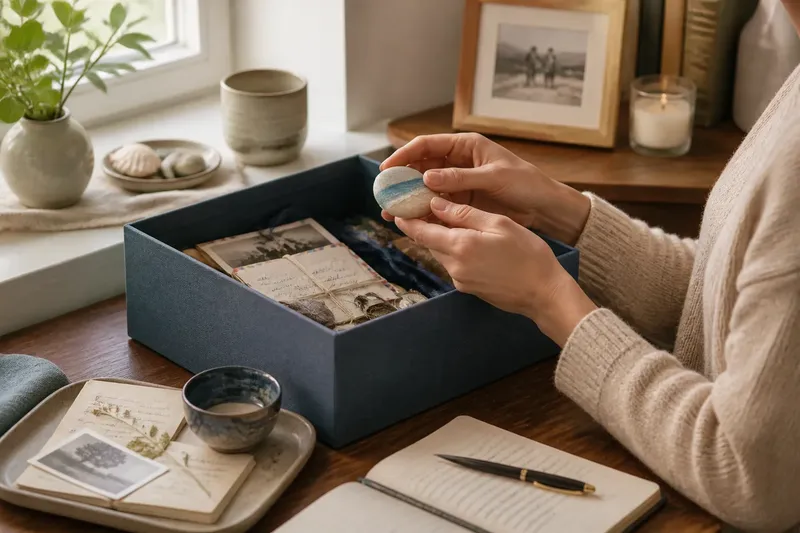
Say you have a painted stone from a beach walk, and the crowded entry shelf makes it feel like one more thing to move while wiping dust. You place it on a quiet windowsill for a while and notice that seeing it there makes you smile, but you do not need it by the front door. The observable result is a better-fitting display location, not a verdict about whether the stone matters.
When a stored keepsake becomes hard to find
What goes wrong: You remember keeping an object but cannot locate it, or you avoid opening a box because everything inside is mixed together. The object is technically preserved, yet access is so uncertain that it feels almost lost.
What usually causes it: “Put it somewhere safe” has no defined destination. Keepsakes may be scattered among seasonal decorations, spare linens and paperwork, or packed without a label that says what is inside. A container can protect an object, but it cannot tell you where to look.
What to try, in order:
- Give keepsakes a consistent home: one shelf, one clearly identified drawer, or a small group of containers in the same closet.
- Sort by the way you would search, not by a perfect archival system. “Letters and cards” may be easier to recognize than “Important paper items.”
- Label the outside with plain language. If an object is wrapped, include a short note inside the wrapping or container so it can be identified without unwrapping every item.
- Place frequently revisited items where you can reach them without shifting heavy or unrelated belongings. Put rarely accessed pieces farther back, but keep their location legible.
For delicate, valuable or material-sensitive items, choose storage materials and conditions suited to the object rather than assuming any box or closet will do. Follow the maker’s care guidance where available; for an item with unusual preservation needs, a conservator can offer specific advice.
When a displayed object is vulnerable to damage
What goes wrong: A keepsake is exposed to direct sun, frequent handling, spills, heat or a place where it can be knocked over. You may find yourself moving it repeatedly to protect it, which turns a meaningful object into a source of low-level worry.
What usually causes it: The chosen spot is attractive but does not suit the object. A sunny sill may fade paper or fabric; a narrow ledge may be unstable; a kitchen counter may be a poor setting for something that dislikes moisture or grease. Different materials have different needs, so one display rule does not fit every keepsake.
What to try, in order:
- Look at the surroundings: light, temperature changes, dampness, dust, traffic and the chance of accidental contact.
- Move the object to a more sheltered location if the current one exposes it to a clear risk. A shaded cabinet or stable shelf may still let you see it.
- Consider a protective frame or case when it suits the material and does not create a new problem, such as trapping moisture or making access awkward.
- If protection would require constant monitoring, store the object and display a photograph or another less vulnerable reminder instead.
It is not worth buying elaborate display equipment just to make every keepsake visible. A simple, stable place that suits the object is often more useful than a complicated arrangement you have to maintain.
When family expectations compete with your own preference
What goes wrong: You keep a gift or inherited object in view because you fear that storing it will look ungrateful, or you feel pressured to display something in a shared room. The decision becomes a test of loyalty rather than a choice about how to live with a belonging.
What usually causes it: People can attach different meanings to the same object. One person may see a teapot as a family tradition; another may value it as a reminder of a particular relative but not want it on the dining table. Those interpretations can coexist. A private place does not erase a connection.
What to try, in order:
- Separate the object’s meaning from its current location. Write down, or say aloud, what you want to remember about it.
- Decide whether you want it accessible, visible sometimes, or present in a shared space. Those are distinct choices.
- If others share the room, discuss the location and care of the item rather than asking them to agree on its emotional meaning.
- Choose a private display or labeled storage if that better fits your preference. Revisit the choice if your relationship to the object changes.
When an object belongs to someone else or its ownership is uncertain, clarify that before changing its location or disposing of it. For ordinary keepsakes you own, you can choose a place that feels respectful to you, even if it is not the most visible one.
How can you tell which place fits?
Should every meaningful object be displayed?
No. Meaning and visibility are separate decisions. Display an object when seeing it adds something you want in the room; store it when privacy, protection or occasional access suits you better.
How often should you revisit a keepsake’s place?
There is no required schedule. Reconsider it when you notice a concrete mismatch, such as repeated searching, a display that irritates you, or a change in the room that makes the object vulnerable.
What if I feel guilty putting a gift away?
Keeping a gift does not require keeping it on view. If it matters to you, give it a known place; if you are unsure whether you want it at all, take time to distinguish appreciation for the giver from a wish to own the object.
Can I display a photograph instead of the original?
Yes, if the image carries the reminder you want and the original is safer or more comfortable in storage. A photograph is not a replacement in every emotional sense, but it can let you enjoy a fragile or bulky object without keeping it exposed.
Let the place reflect how the object matters now
A keepsake’s place can change without its meaning becoming smaller. You might display a shell during one season, then put it away when the shelf takes on another purpose. You might keep a letter in a labeled folder because you want to reread it privately, or leave a sturdy bowl in daily use because that is how its story feels alive to you.
When you are deciding whether to keep, display or store a keepsake, return to access and significance: do you want to encounter it often, and what do you value about it? Choose the least complicated place that supports those answers. If the object becomes hard to find, too exposed, or tiring to see, treat that as useful information and adjust its place—not as evidence that you cared about it incorrectly.